Welcome to Reaction Kinematics
This is a Python library for calculating relativistic two-body nuclear reaction kinematics.
This package is designed for students and researchers working in nuclear and particle physics who need reliable relativistic kinematic calculations for reactions of the form:
projectile + target → ejectile + recoil
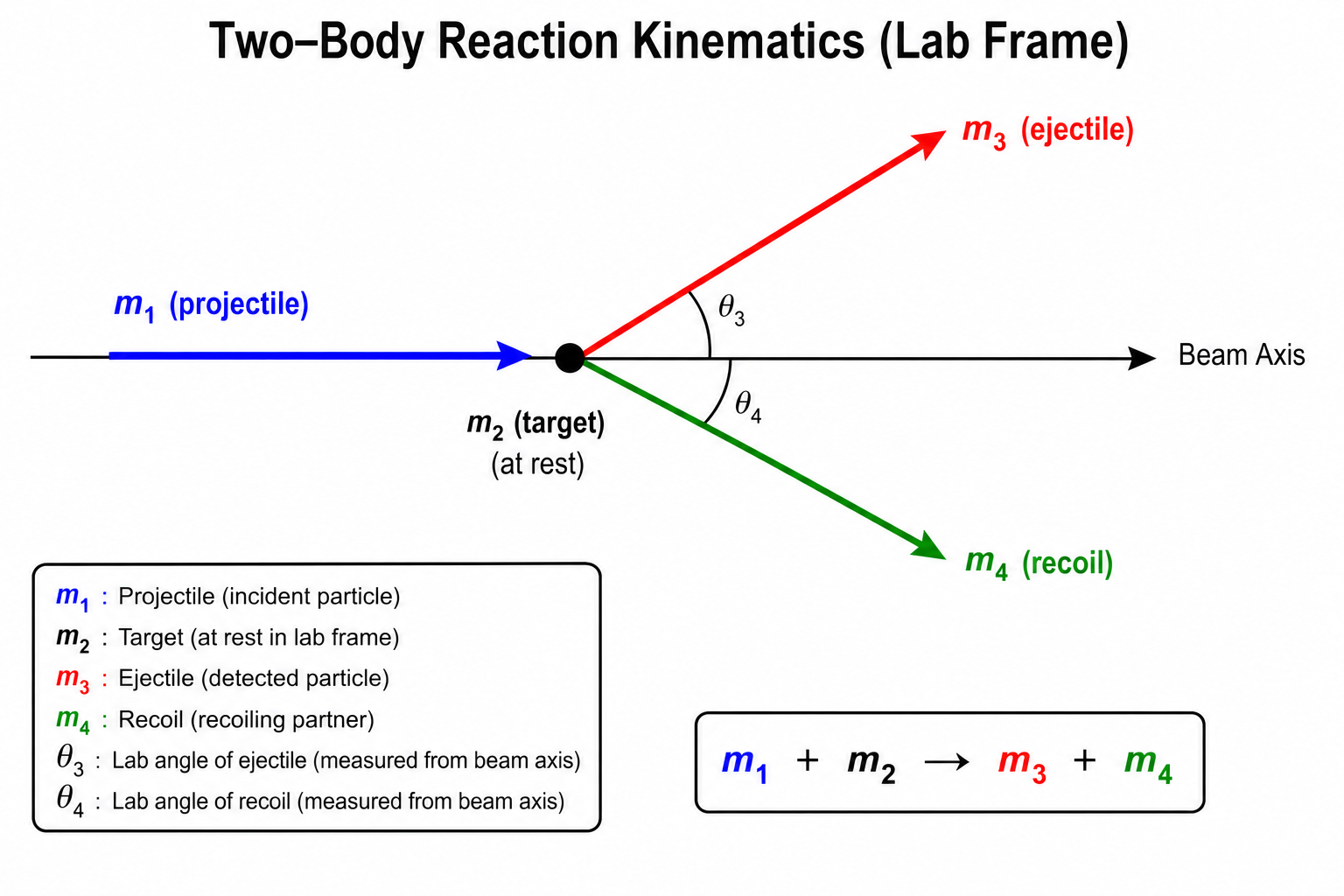
This code can do:
- Relativistic two-body kinematics
- Center-of-mass and lab-frame quantities
- Energy, angle, momentum, and velocity calculations
- Support for multi-valued kinematic solutions
Install
pip install reaction-kinematics
How to use
Create a reaction by specifying the four particle masses. The beam energy is passed separately to each calculation method.
Reaction
We define a reaction with these variables
- mass1 (Projectile)
- mass2 (Target)
- mass3 (Ejectile)
- mass4 (Recoil)
All masses are converted internally to MeV. Kinetic energy is assumed in MeV unless specified otherwise.
For example, for the reaction ³H(p,n)³He:
from reaction_kinematics import Reaction

# or equivalently:
# rxn = Reaction("3H(p,n)3He")
rxn = Reaction("p", "3H", "n", "3He")
Units
- Masses are internally stored in MeV/c²
- Energies are in MeV by default — supported units:
keV,MeV,GeV,TeV - Velocities are given as fractions of c
- Angles are in degrees by default — supported units:
deg,rad,mrad
energy_unit governs every energy- and momentum-valued output as well as the
energy input — e.g. energy_unit="keV" returns energy3_lab/momentum3_lab/etc.
in keV, not just interprets the input beam energy as keV. angle_unit works
the same way for angle-valued outputs.
Every kinematics method below returns a KinematicsResult: it behaves like a
plain dict (result["theta3_lab"]), and also carries a .units dict giving
the pint Unit of each key:
data = rxn.kinematics_table_at_beam_energy(4000.0, energy_unit="keV")  # 4 MeV
data.units["energy3_lab"]  # Unit('kiloelectron_volt')
Reaction.output_units(angle_unit=..., energy_unit=...) gives that same
mapping without running a computation first.
Compute Arrays
To generate arrays of kinematic quantities over all center-of-mass angles, use kinematics_table_at_beam_energy(beam_energy). The units for beam_energy are MeV by default but can be specified by the user using the energy_unit keyword.
data = rxn.kinematics_table_at_beam_energy(4.0)
This will return a KinematicsResult containing the following:
cos_theta_cm: cos(θ_CM)theta_cm: CM angle (deg)theta3_lab: Ejectile lab angle (deg)theta4_lab: Recoil lab angle (deg)energy3_lab: Ejectile energy (MeV)energy4_lab: Recoil energy (MeV)velocity3_lab: Ejectile velocity (unitless, reported as a fraction of c)velocity4_lab: Recoil velocity (unitless, reported as a fraction of c)momentum3_lab: Ejectile momentum (MeV/c)momentum4_lab: Recoil momentum (MeV/c)jacobian3_lab: dΩ₃(lab)/dΩ(cm) — converts a lab-frame differential cross section to the cm framejacobian4_lab: dΩ₄(lab)/dΩ(cm) — converts a lab-frame differential cross section to the cm frame